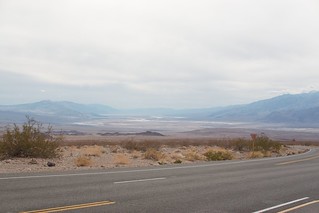
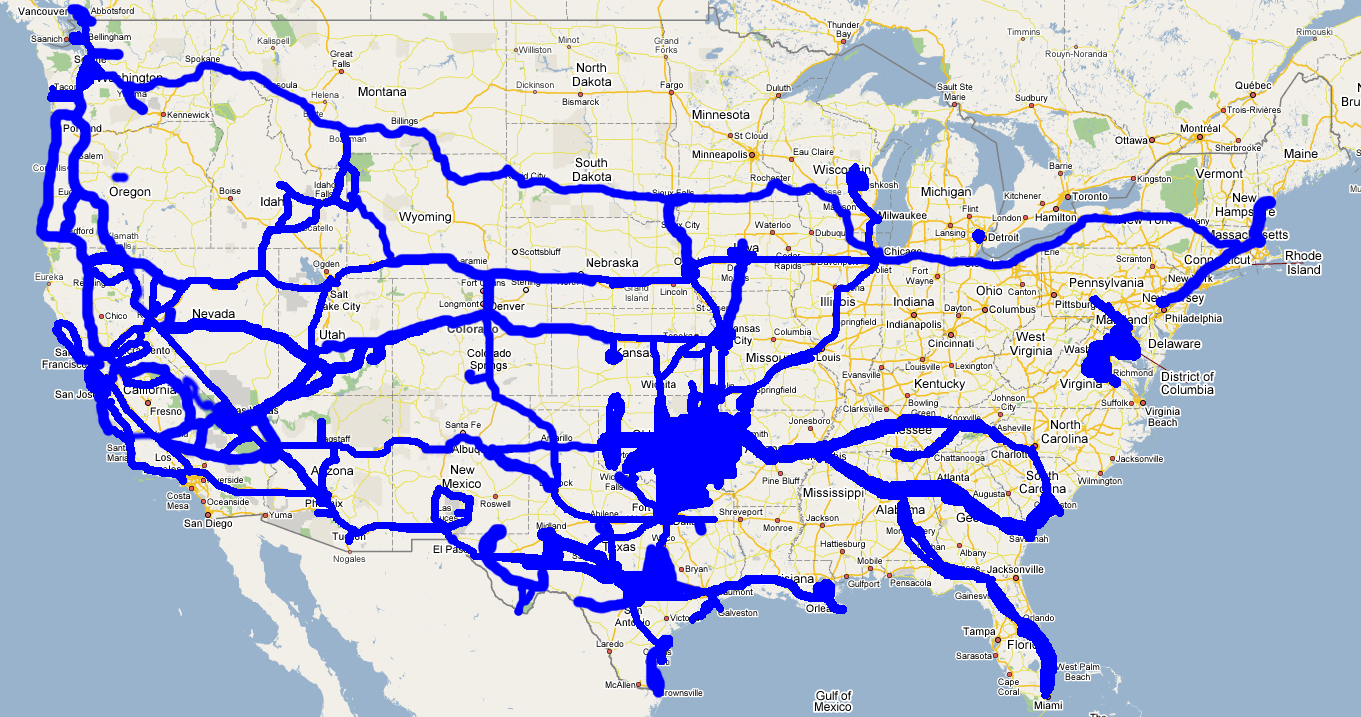
I decided to go to Death Valley for a week to unplug and stayed at the Furnace Creek Ranch. People always wonder why I go out there instead of head off to the beach, and while I love laying on the beach too, sometimes it’s nice to go where it’s dead quiet. In some ways it’s sort of like trekking to the middle of nowhere to Burning Man, except in DV you have the option of staying at hotels. (Las Vegas is 2 hours from DV) Having said it’s quiet, right now is actually the biggest tourist season of the year since the weather is mild, but DV is a huge place and everyone returns to camp/hotel/RV at night. At places like FCR there’s plenty of casual social gathering around the fire pits in the evening, if you want company you can find it. Otherwise, if you’re a night owl like I am and have a vehicle, you have complete free reign of the place after the sun sets. Venture just out of town, you will not see another soul or vehicle until morning.
Nighttime is a big part of what makes this place so amazing. DV just recently got some special blah blah acknowledgements of being one of the darkest places in the northern hemisphere and I believe it. Bring binoculars, find a remote parking lot, lay down a blanket, and be amazed at the stars for hours. They’re very numerous and sharp, like lightbulbs on strings. The only thing you hear is the wind, the tinnitus in your ears, and maaaaybe some coyotes off in the distance. It doesn’t suck!
For an interesting experience I recommend driving out to Badwater (the lowest point in the basin, and North America for that matter) at night in the dead of summer. Even at midnight it’s still 111 F, virtually no wind/breeze, pitch black (save for stars/moon), dead silent, and nothing’s around for 20 miles. I think of it as the dry walk-in equivalent of a sensory deprivation tank as you walk around and are hugged by the warmness.
My DV travel tips, for going to/from the SF Bay:
Never been to Yosemite? Cut over the Sierras on highways 108 or 120, catch highway 395 south.
Going through Bakersfield and then over? Ignore your GPS telling you to take highway 178 (especially on the way back), it sucks. It’s a windy canyon highway and you’ll be stuck behind somebody riding the brakes all the way down at 45 mph.
Avoid shortcutting using the Trona/Wildrose road, it sucks. The road is not maintained well and patched all to hell. I discovered this at 1 am and was not pleased.
Those windy turns through the passes you take at night? Yeah, the darkness conceals you’re driving on the edge of a mountain with a 2000′ drop off on one side and there’s no guard rails.
Places like Panamint Springs, Stovepipe Wells, Furnace Creek are surprisingly far apart, 20-30 miles.
Get gas in Stovepipe Wells during the day. FC has 24/7 gas but it’s easily $1-$2/gallon higher than the rest of the world. Likewise since Panamint Springs is so remote and purely diesel generator powered, their gas is even higher; I think I saw $6.95/gallon this trip.
There’s AT&T EDGE coverage around Furnace Creek, but that’s it once you enter the park unless you get on a mountain top.
One thing I was amused by was hanging out in front of the FCR store and watching the tourist machine at work. The place seems to do a pretty good job processing bus loads of retirees. A big tour bus rolls in, stops at the curb and all of the passengers are herded up the steps into a big buffet room. An hour later the bus returns, everyone is herded back on the bus and driven the 0.25-0.50 mile back to the buildings with guest rooms. The bus door opens, they all again are herded into the same ground-floor unit to their rooms. Repeat the reverse the next morning, and then I guess they go off to their next tour destination or back to Vegas.
The after-hours crowd is what makes the ranch fun. The tourists and retirees usually clear out by 8 pm or so, and the night crowd starts trickling in (or continuing on) to the saloon or the fire pits in front of the store. What’s nice is that you don’t have to be a guest, any random person can come hang out. Pretty much everyone I chatted with are well traveled, come from all over, and have fascinating stories. Later on the employees get off shift and join in. Be nice to who cooked and served your cheeseburger, you will likely run into them here! Many seem to thrive on adventure too, lots of them are 20-somethings who signed up to work in national parks, traveling from park to park as they’re assigned.
While I was there I spotted a small fleet of Ford Focus and Fusion cars with Michigan manufacturer plates, all with dashes decked out in all sorts of digital readouts; I’m assuming GM product testing. Thursday night some sort of film crew rolled in from LA with several giant camper trailers, with some tall skinny girl with black hair and a clipboard buzzing around who was clearly running the show. As I left Friday morning I noticed the crew was apparently filming at the Old Borax Works, they had CHP present to block off the highway, trailers were set up on the parking lot, and people were huddled out on various hilltops. I have no idea what they were shooting, but I’d like to see it!
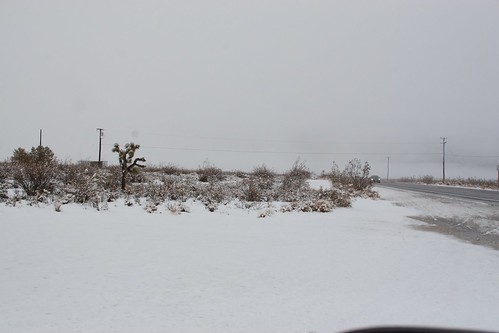
It was also sprinkling when I left Death Valley which was pretty nice and smelled amazing. What I didn’t realize is that this meant SNOW was waiting for me in the Sierras! Somewhere between Lone Pine and Bakersfield the sand on the side of the road turned to snow. Several inches had fell, the place was covered!
A couple of months ago I acquired a stack of Raspberry Pis because they were so hard to get, might as well get it over with. Of course, once I got them they went untouched for weeks. I eventually started selling off part of my stash to other coworkers to help spread the fun. After building the IKEA cluster using 10 mini-itx Atom boards in a HELMER cabinet, the next logical progression would be to build a Pi cluster. I began to wonder what one could even do with such a tiny rig (it’s fantastic for learning Chef or Puppet system automation), and half jokingly wondered if it could run Hadoop.
A Pi cluster is not new, people have done this before. Unfortunately it usually involves a gigantic stack of power strips and USB power adapters. I wanted to get rid of all of that and because I knew the Pi can be powered via USB or header, so I wired up a small power bus. Now, multiple Pis are powered by a standard Molex drive connector (which gives you 5V on the red/black wires) using a leftover ATX PSU. By my measurement, each Pi draws 400 mA, but I don’t know if/what the real limits are of the 5V output of the PSU though. It’s vague and hand-wavy, but I do know I haven’t yet burned my apartment down.
I had leftover IKEA HELMER drawers from the last project, which are basically 9.5″ wide, 4″ tall, and trimmed to 11″ deep. This perfectly fits 8-9 Raspberry Pis and a Netgear switch (PSU is elsewhere), but such a small switch only provides 8 switch ports with one of those ate for uplink, putting me at 7 RPis for my cluster. There doesn’t seem to be a compact 10/12/16 port switch that fits into the drawer so sadly some potential is lost.
The project wasn’t without setbacks, finding a simple way to mount them all took work. At first I tried stringing them up on pieces of coat hanger wire, but this was too flimsy to be of any use. The ethernet cabling wanted to pull everything around despite being zip-tied in place. I tried the threaded road approach this time. The holes in the board are really intended for fabrication and not mounting swears the RPi foundation, so nothing standard size fits through them. Finally in the back of the hardware store I found one 3′ piece of 4-40 (I think!) threaded rod that fit. It was a complete pain in the ass to thread 7 boards between a sandwich of nuts at the same time even with a drill to do the twisting, but the result was worth it after mounted in the drawer. The Pis are mounted solid and are eaaaaasy to work around now.
Low power draw: 7 boards, 2.8 amperes at 5 volt
Yes, if you blow one in the middle you’ll have to disassemble it to get it out, this happened to me before I started using the rod. The coat hanger solution was so shitty that somehow I shorted something and grey smoke rolled off a RPi. I took it out and later tested it, the little sucker STILL BOOTS. I have no idea what I fried on it, but they’re more resilient than I expected.
For power cabling, I used some breadboard jumper wires I had laying around. Cut them in half, the header plugs onto the RPi, other ends get soldered into a terminal. Instead of switches to power off individual RPis, I happened to have 3″ male/female jumpers which were perfect to loop up front to plug/unplug power conveniently. Alas I can’t get to the HDMI ports, I figured access to GPIO pins were more important.
Fry’s had a great sale the other day on 32 GB SDHC cards ($10!) so I maxed out most of the boards with storage. Ethernet is just a 1′ cat 5 (cat 6 is too stiff really) patch that’s looped and velcro’d in place.
All in all, the boards together draw 2.8 A at 5 VDC when running a UDP iperf test. The AC outlet meter continuously shows it drawing 30 W however, so I think this indicates overhead/inefficiency in the PSU. Best of all, it’s PERFECTLY SILENT. No fans, the heat it does give off is barely noticeable. It just sits there like this bizzaro computation toy, blinking away.
On to Hadoop!
Hadoop + HDFS + MapReduce
Why would you do such a silly thing? To see if it can be done!
I still run Raspbian on the boards, which is basically Debian 6. I haven’t had any particular problems building or getting normal packages to work on the RPi. It just works and cranks away like an old Celeron. There was doubt amongst others if Java would even work on them, be it memory consumption or ARM compatibility. The Raspbian distro includes OpenJDK which seems to work just fine.
Finally one night after I got all of the basic system Chef recipes ironed out I decided to just try installing Hadoop to see what would happen. In the course of my day job I don’t administer Hadoop infrastructure and only have a casual idea of how it all fits together, so it was all completely brand new to me. Being the impatient type I started rage googling and quickly found excellent tutorials on how to install Hadoop on single node and multi nodes by Michael Noll. The official Hadoop quick start guide seems sort of lacking in a few places, but his are complete and informative in the process. There were a few bumps, but nothing installing more packages or googling couldn’t solve quickly.
I think I got the cluster up and working with a couple of hours, start to finish, complete with HDFS. Get a single node working first, that’s 85% of the work done. The rest is stamping out the single node over and over X nodes, then updating the config to point at one NameNode. Even the included start-dfs script will take care of starting/stopping DataNode services on your slaves for you, so you only have to fiddle with the master.
HDFS write (730MB ISO file): 6 MB/sec read, 1.2 MB/sec write (5 minutes to copy an ISO to DFS, 2 minutes to copy back)
Getting MapReduce took some tuning because the default Java heap size is 1 G (ha!). Interestingly I was still able to run an example MR wordcount job from the tutorial on a single RPi with the default heap despite it swapping heavily and dropping some workers. After about 20 minutes later it finished and wrote its results. On the cluster however the example eventually failed after a long time, due to general memory starvation. Tuning the Java heap way down to 256 MB setting made the situation bearable, nodes could finally successfully finish small example MR jobs in a few minutes.
It’s amusing to note all this breaks the Hadoop best practices, going right down the list and snubbing every requirement. Tiny amounts of ram, slow I/O, slow network, slow everything. I guess the only thing going in performance’s favor is the fact that raw reads from SDHC are 10x faster than writes. Having said that, it’s all stock everything so performance can only get better if one really wanted to crawl all over it. In the end it’s still a good exercise in learning how something new works!
It remains to be seen if I keep the RPis in this configuration, or I swap them out later with Cubieboards. Either way, the form factor means it can be inserted into the IKEA cluster cabinet for some “yo dawg I heard you like clusters…” action.
EDIT: MapReduce example with ‘wordcount’:
MapReduce is pretty painful. Here I’m running a MR wordcount job using 2,098,367 bytes (!) of plain text as input … 10 minutes and 32 seconds later the job completes.
hduser@rpi01:/opt/hadoop$ time bin/hadoop jar hadoop*examples*.jar wordcount /user/hduser/txt /user/hduser/txt-out1115
13/03/13 07:20:53 INFO input.FileInputFormat: Total input paths to process : 2
13/03/13 07:20:54 WARN util.NativeCodeLoader: Unable to load native-hadoop library for your platform... using builtin-java classes where applicable
13/03/13 07:20:54 WARN snappy.LoadSnappy: Snappy native library not loaded
13/03/13 07:21:02 INFO mapred.JobClient: Running job: job_201303130634_0003
13/03/13 07:21:03 INFO mapred.JobClient: map 0% reduce 0%
13/03/13 07:22:36 INFO mapred.JobClient: map 1% reduce 0%
13/03/13 07:22:40 INFO mapred.JobClient: map 2% reduce 0%
...
13/03/13 07:26:38 INFO mapred.JobClient: map 98% reduce 16%
13/03/13 07:26:42 INFO mapred.JobClient: map 99% reduce 16%
13/03/13 07:26:47 INFO mapred.JobClient: map 100% reduce 16%
13/03/13 07:28:50 INFO mapred.JobClient: map 100% reduce 33%
...
13/03/13 07:30:02 INFO mapred.JobClient: map 100% reduce 100%
13/03/13 07:30:59 INFO mapred.JobClient: Job complete: job_201303130634_0003
13/03/13 07:30:59 INFO mapred.JobClient: Counters: 30
13/03/13 07:30:59 INFO mapred.JobClient: Job Counters
13/03/13 07:30:59 INFO mapred.JobClient: Launched reduce tasks=1
13/03/13 07:30:59 INFO mapred.JobClient: SLOTS_MILLIS_MAPS=741642
13/03/13 07:30:59 INFO mapred.JobClient: Total time spent by all reduces waiting after reserving slots (ms)=0
13/03/13 07:30:59 INFO mapred.JobClient: Total time spent by all maps waiting after reserving slots (ms)=0
13/03/13 07:30:59 INFO mapred.JobClient: Rack-local map tasks=1
13/03/13 07:30:59 INFO mapred.JobClient: Launched map tasks=3
13/03/13 07:30:59 INFO mapred.JobClient: Data-local map tasks=2
13/03/13 07:30:59 INFO mapred.JobClient: SLOTS_MILLIS_REDUCES=276932
13/03/13 07:30:59 INFO mapred.JobClient: File Output Format Counters
13/03/13 07:30:59 INFO mapred.JobClient: Bytes Written=470902
13/03/13 07:30:59 INFO mapred.JobClient: FileSystemCounters
13/03/13 07:30:59 INFO mapred.JobClient: FILE_BYTES_READ=733821
13/03/13 07:30:59 INFO mapred.JobClient: HDFS_BYTES_READ=2098588
13/03/13 07:30:59 INFO mapred.JobClient: FILE_BYTES_WRITTEN=1539326
13/03/13 07:30:59 INFO mapred.JobClient: HDFS_BYTES_WRITTEN=470902
13/03/13 07:30:59 INFO mapred.JobClient: File Input Format Counters
13/03/13 07:30:59 INFO mapred.JobClient: Bytes Read=2098367
13/03/13 07:30:59 INFO mapred.JobClient: Map-Reduce Framework
13/03/13 07:30:59 INFO mapred.JobClient: Map output materialized bytes=733827
13/03/13 07:30:59 INFO mapred.JobClient: Map input records=44877
13/03/13 07:30:59 INFO mapred.JobClient: Reduce shuffle bytes=733827
13/03/13 07:30:59 INFO mapred.JobClient: Spilled Records=102008
13/03/13 07:30:59 INFO mapred.JobClient: Map output bytes=3474212
13/03/13 07:30:59 INFO mapred.JobClient: CPU time spent (ms)=518320
13/03/13 07:30:59 INFO mapred.JobClient: Total committed heap usage (bytes)=413401088
13/03/13 07:30:59 INFO mapred.JobClient: Combine input records=361196
13/03/13 07:30:59 INFO mapred.JobClient: SPLIT_RAW_BYTES=221
13/03/13 07:30:59 INFO mapred.JobClient: Reduce input records=51004
13/03/13 07:30:59 INFO mapred.JobClient: Reduce input groups=44447
13/03/13 07:30:59 INFO mapred.JobClient: Combine output records=51004
13/03/13 07:30:59 INFO mapred.JobClient: Physical memory (bytes) snapshot=397709312
13/03/13 07:30:59 INFO mapred.JobClient: Reduce output records=44447
13/03/13 07:30:59 INFO mapred.JobClient: Virtual memory (bytes) snapshot=1056927744
13/03/13 07:30:59 INFO mapred.JobClient: Map output records=361196
real 10m32.817s
user 0m32.830s
sys 0m1.950s
It’s been fantastically warm this weekend for once, enough to get me outside long enough to notice my plants have started budding/flowering! The pink jasmine, lavender, and this succulent are all showing signs of new life.
I’m taking a couple of weeks of vacation soon, which will be awesome. I don’t have many ideas on what I want to do; I at least want to go to Death Valley for a couple of days, then visit a friend.
I’m in a quasi-contemplative mood (and sick with a cold) and I wanted to add my own version to go with all of the 2012-in-review stories I keep seeing on the news. To be honest, 2012 has been an exercise in existence and not so much actual living.
The good:
After basically a decade of yearning I finally live in the San Francisco Bay Area. As a diehard tech person this has been the hot spot where all the exciting things happen. For years I freaked out and balked at the cost of living, not knowing if I’d be able to get a job to afford it all on my own without roommates. I finally made it (by way of Seattle) at the start of 2012!
I got the job of my dreams. This one was tough. As an engineer, I really can’t ask for a better place to work. I’m free to really crank on interesting things without all the distractions such as phone calls, angry customers, office politics, incompetent coworkers/groups. Every single person I work with is brilliant and they’re always willing to help out.
I’m out of Washington. It’s no secret I hated it there, it just wasn’t for me.
I adopted Charlie, my 2nd tuxedo cat.
I discovered microelectronics aren’t as hard as I expected; I also discovered homemade drones which has lit my imagination on fire.
I love California, I wish I had moved here years ago. (I’ll secretly admit I even like it more than Texas.) It’s oddly hard to fly somewhere else now, I don’t want to leave!
The bad:
I let my heart be broken in a big way and it continues to hurt. For months and months I would wake up angry at myself for getting into such a situation, yet I knew full well ahead of time what the risks were. On one hand it’s fascinating to see how powerful brain chemistry is, on the other hand it’s a real bitch.
I swam through the weeks. At some point I didn’t even care if I blew a Friday night because I knew another one would be here before I knew it. While this made the weekends come fast it also made the months tick by, everything was a blur. I can’t tell you what I did a week ago, let alone three months ago.
I had a head-on collision with tech burnout and the wreckage is still smoldering. I’m flat out sick of tech right now. I don’t even want to hack on my home projects, I’d rather go for a hike or drive along the coast. There are many causes but primarily I just didn’t step away enough.
I’ve made zero friends outside of work. For a large part of the year I would be so exhausted when I got home, I just didn’t want to deal with people or go out at all. I became very anti-social (which is a huge irony considering where I work).
Didn’t visit my family in Oklahoma or friends in Texas at all, other than the family at Thanksgiving and Christmas.
For 2013, I need to get my house in order. Before I walked out the door this morning some televangelist on the telly said something that stuck with me (paraphrasing): “If you’re not enthusiastic and living your life, you’re just existing”. I strongly feel I spent all this year just existing, waiting for something to happen; waiting to get through another busy day; waiting for the weekend so I could decompress and sleep.
Despite how anti-social and a hermit I’ve become, I need to make a point to get out to meet people (starting with a party I was invited to on NYE). I need to get involved with or re-discover non-tech hobbies (cooking?, lock picking?) and go on real vacations even if I have to go alone.
I finally got proficient enough at work that I stopped with the weekend studying and hacking, which is finally helping me want to step outside to explore. I often forget things like Merritt Lake are just 15 minutes away via BART, Santa Cruz is ~40 minutes away, the coast is ~30 minutes away. All this awesome California stuff around me that I never think about because I just wanted to stay home.
I just want to be normal and enthusiastic about life, I hope I can accomplish this in 2013.
This summer I discovered the Arduino and was completely fascinated by how simple it was to rig up things like circuits, sensors, motors, servos, whatever and make it do real things. And it was cheap! I never have really tried my hand at microcontrollers or hardware hacking despite having a bit of the ham radio bug. I guess my programmer friends always made it seem very hard; maybe it was and its gotten to the point where it’s accessible to more people. Anyways, it’s awesome and I realized that with all the dodads you can connect to it and write scripts for, imagination is the limit of what you could do. It got me back into fiddling with electronics and learning building projects is way easier and more forgiving than I expected.
Then I learned about the Raspberry Pi. It’s a little board intended as an educational device for children, to be an extremely low cost ($35!) yet fully functional Linux computer that can actually “do” things other than blink lights. It straddles both worlds, you can ignore the hardware aspects of it and use it to learn Linux, or you can ignore Linux and go build a autonomous rover with it.
Like the Arduino it can be connected to all manner of electronic devices, but it has a modern treatment with 512MB RAM, SD storage, HDMI video output, graphics support, and network. It’s a “real” computer in its own right, running its own copy of Linux (albeit compiled for ARM) and can run graphical applications. And it’s smaller than an iPhone. If you ever wanted a computer to teach somebody the basics of electronics/programming/robotics/hacking, it doesn’t get better than this. This thing is brilliant and I want to see it succeed as a concept!
If your kid is building a project and accidentally shorts out the 5V rail and destroys the board, so what! It’s cheap enough to buy the kid a new one, help them learn from his/her mistake and move on. That’s just not possible with more expensive gear; this removes that fear. One of the downsides of this board is that it’s capable of a lot of things so it feels like a complete waste to make it “only” do something simple like watering the plants and opening the drapes.
[Un]fortunately the RPi has caught like wildfire the imagination of adult tinkerers everywhere. They’re making them as fast as they can now, but there are still long order lead times. It’s worth it, go buy some! My first project was to hook up a Garmin GPS and try to build my own stratum 1 NTP server. You know, in case I want my clocks on my computers to be within microsecond accuracy. The setup sort of works but the accuracy is way off even with a PPS signal, so I’m still figuring that one out.
Next comes the Cubieboard. Of course the first thing I wanted to do with the Raspberry Pi was buy a bunch of them, shove them into a shoebox and have a little ARM cluster that could serve up “Hello World” with nginx. The problem is, the RPi doesn’t really support hard drives, it’s not intended to. You *can* plug in something to the USB ports which is perfectly fine. Cubieboard is the next logical progression, another tiny ARM system that includes SATA and more memory. It has even more pins for wiring up gizmos than the Arduino or Raspberry Pi. They target price is $49, they just ended a crowdfunding thing for a new production run. Of course now I want to make a little server farm out of them.
And yet another really interesting thing is the Parallela system from Adapteva. This thing is sick and is designed for sheer power with low power consumption. Lots of tiny cores on the die. This isn’t designed for hardware tinkering, more intended to produce very powerful embedded applications. They got their Kickstarter funding and should be sending out units in 2013. I like what they’re doing and hope they succeed, I kicked in and bought two 16-core boards.
Tidy Cat “multi-cat long lasting” (orange) litter + Felix = endless digging and flinging of litter all over the bedroom, despite even weekly changing of litter and soapy wash of litter pan and daily scooping
Tidy Cat “multi-cat instant action” (cyan) litter + Felix = instant, overnight stop to flinging; vacuum cleaner rejoices, litter lasts for weeks now
Tidy Cat “multi-cat instant action” (cyan) litter + Felix + Charlie = endless digging and flinging of litter all over the bedroom, despite even adding a 3rd litter box and being next to an open window
of course this means
Tidy Cat (cyan) + Tidy Cat (orange) mixed together + Felix + Charlie = 48 hours with a clean floor!
Gather round, it’s time for the old person to tell a story about how things used to be!
Mid-Late 1990s: no such thing as mobile, I stuck in my 3com PCMCIA card and dialed somebody like CRIS or long distance into my own ISP’s modems. I have flip phones through US Cellular and they frequently fall back to AMPS.
Late 1990s: I get an AT&T “One Rate Digital” TDMA phone for the low price of $99/month. I can text but I don’t see the point. I saw one fancy US Cellular data modem plugged into a flip phone and thought “not bad”. My cutting edge friends in Silicon Valley had Ricochet modems which was the equivalent to a wireless dialup modem. For work I carried an alphanumeric pager to which NOCOL/Nagios sent short messages to like “%SYS-1-UPDOWN: Frame-Relay1/0/13.0 is DOWN” when shit broke. At the movies I overhear some girl behind me ask “why would anyone carry both a phone and a pager anymore?” I think for a while I may have even carried two cell phones, one on US Cellular (CDMA) and another on AT&T (TDMA/GSM).
Early 2000s: I move to Tulsa, have TDMA voice phone service. 802.11 wireless arrives! On the road, still no internets. Here I had a Nokia 6300-something. I started actually texting people for real purposes. For Nagios I try out this e-mail to SMS text message thing and become conditioned to breaking out into a panic when I hear the Nokia text tone at 2 AM. When I was at TU, I bought a Handspring with an Omnisky Minstrel modem. I don’t even remember what data service I subscribed to, but I could see greyscale internets! It was really cool to sit on my friend’s couch, proceed to use my wireless modem and ssh to one of my ISP’s modem banks and feed it AT commands to make an outbound phone call to my friend’s house phone, then giggle while he answered the phone and realized what I had done. Other friends replayed parts of the Matrix, messaging their friends on Yahoo or AIM moments before knocking on their door and scaring the shit out of them.
2004-2008: 802.11 wireless/ethernet in most hotels. Mobile internet consisted of a USB dongle connected to a small external antenna, war driving and camping out in parking lots leeching from whoever was around. State of Texas offers free wifi at most/all interstate rest areas, brilliant thinking to get tired travelers off the road; I frequently used them on my many road trips across the state. Theoretically my Nokia 6310i could do data, but it was so old I don’t think anyone supported it. For work on-call duties I used a Verizon CDMA data card in a Panasonic Toughbook which worked pretty well all around Austin. Here I learn the amateur radio nerds have been bouncing TV off satellites and packets off the moon since forever. Go to Amsterdam to work, slap in a new pre-paid SIM at the airport and now I have a local number.
2008-2009-ish: sometime I got a 3G iPhone and had an unlimited data plan. Mobile use consisted of taking photos with my camera, downloading to my laptop, connecting my phone, emailing to flickr or whatever. Somehow this was better than leeching wifi with a special antenna. Wireless is everywhere. Going deep into the Nevada desert meant my phone dropped all the way down to GPRS, with the little “o” icon for data connectivity. Pretty impressive that I had at least minimal data in the middle nowhere.
2009: now I have an iPad and iPhone with a camera, still no way to tether data. At least now I can plug my compact flash cards from the camera into the iPad, upload photos that way. I can go pretty much anywhere except rural Oklahoma and get some sort of 3G or EDGE data service. Voice? what’s voice?
2010: I needed tethering for on-call duties, got a Verizon Mifi thingy. This is actually pretty cool for laptops, press a button to turn it on, throw it in your bag, open up your laptop. I think I even get AT&T 3G service in parts of Death Valley, if not EDGE in Furnace Creek. Oddly enough in Oklahoma I can get Verizon CDMA service for Mifi, but zero cell service for my AT&T iPhone. I get a AT&T pico-cell thing for my parent’s house, full voice+SMS+MMS service. I have enough 3G contraptions I don’t even care if places have wifi or not. Work causes my text usage to explode, making me get an unlimited text plan.
2011-2012: everything is mobile. There’s an app for everything. I never talk to anyone except my parents on the phone. I consume lots of email but never send any. I write blog posts about how I used to sit in the parking lot with 802.11 antennas.
I finally gave in, adding fans and a 620 W ATX PSU to the IKEA cluster. Fortunately it remains fairly silent and draws little power.
If I was going to power 8-10 servers in the cabinet, multiple 192 W 12VDC power supplies got clunky and the hard drives generated a ton of heat that couldn’t be passively cooled well. Not only that, I needed to maintain a ~40W buffer for hard drive spinup on each PSU so it was inefficient to go this way. Going the PSU route also simplified a lot of wiring.
I have a single Antec 620 W ATX PSU mounted at the top of the cabinet, using one of the HELMER drawers as a mount. I don’t actually use the ATX power cabling here, I have it shunted with a terminator so it’s always on. I take the two 4-pin 12V feeds and tie these to a pair of little 8-screw terminals. From there each motherboard has a picoPSU (really a DC-DC converter) ranging anywhere from 80W-150W.
The PSU route works really well for a several reasons. The particular one I has detachable connectors, so I can get rid of crap I don’t need in here. It has a big fan, virtually silent. Mounted in the top of the cabinet in a drawer it not only gets rid of wiring clutter on the floor, but the fan helps pull the heat off the switches. Plus, tons of headroom. Napkin math says 10 systems at 50 W peak still gives me about 10% headroom at max so I’m reasonably secure I won’t burn my apartment down. As it stands right now, seven motherboards running a CPU stress test + eight hard drives draws around ~220 W. The entire cabinet has a footprint of 4 cables: ethernet, PSU power and power for two switches.
As far as fans go, I mounted two 120mm fans on the rear door and connected them to systems #1 and #4. I bought the slowest, biggest fans I could get at 1000 RPM. With the motherboards running the fans, they keep it around 870 RPM. The result was obviously huge, components dropped 30-40 C! Hard drives are now no longer just beyond the threshold of painful to hold onto.
With the PSU in the rear of the top drawer and wiring terminals in the front, there was a lot of empty space that was perfect for a pair of 8-port Ethernet switches. At first I thought I was going to have to build some little shelf railing contraption to hold it, then I realized I could take a 5″ deep section of drawer, turn it upside down, cut notches for the power cabling underneath and I had a tidy little shelf for the switches.
In the process I cut the power tray in half, thinking it would be handy to make the PSU totally separable from the wiring terminals. In practice this wasn’t a good idea because sliding the first motherboard underneath makes it super easy to snag SATA cables. Oh well.
I also trimmed a half inch off the end of each system tray to make room for the ethernet cables to flex. Sawing through eight sheets of acrylic with a hand saw for such a small amount was a giant pain in the ass, but the result is worth it. The door can shut flush without bunching up the cabling.
Now I’m considering how I can make some sort of drive tray…
Just how many 2.5″ hard drives can you cram into a 3″ x 9.5″ x 15″ space!
I can’t believe it’s Friday again already. I feel like I’m swimming through the week now. I don’t really understand what’s going on the past few weeks. Am I so busy that I ignore half the day, is it so routine there’s nothing to remember, or is the universe contracting?
I can’t believe it’s already August. AUGUST. I’ve lived in California for 6 months now and time has just flown by. I’m having trouble accepting that. I feel like I need to be out exploring all the time since it’s all new, but man, it’s nice sitting out on the balcony in the sun and staring at a laptop (and not thinking about work). I’ve been putting off a trip to Death Valley for a couple of months now, it’s always some procrastination or excuse. “New cat” “vet appointment” “need oil change” “woke up too late”…
I adopted a new cat, Charlie, a couple of weekends ago from the Hayward Animal Shelter. He’s a black and white tuxedo cat, white paws/feet and white chest, and about a year old. He was a stray from the rough streets of Hayward, but super friendly. Him and Felix are still battling out who’s dominate, Charlie is certainly not shy about pouncing and rough play. One day I think one has the upper paw, the next day the other one is in charge (my bet is on felix). Felix is much quieter now, he doesn’t flop down to vocalize his boredom, he’s usually off doing other things now.